Oscar Watson writes
The switch from a world lived ‘with’ media to the current ‘Mediapolis’ in which we live ‘in’ media (Dueze, 2011, p. 137) has increased the reliance of professionals in the event management industry on social media interactions with their audience to drive business. From local gig runners to those on the organisational committee of an international music festival, professionals on all levels must consider the ever-increasing importance of social media and how it shifts the value of the role of the audience.
The participatory culture that social media has introduced over time has empowered, even encouraged, consumer audiences to create, curate, circulate and/or critique content, making them more able, tangible and less predictable (Rosen, 2006). This means that the ‘networked public’, partially formed by the audience that communicates through and is restructured by aforementioned social media (Boyd, 2011), will essentially take over the publicity side of any event through sharing their own content on platforms. Any practitioner wishing to be effective should harness this consumer expectation to share content, by producing content, be it an event poster, images or videos, to be circulated.
Indepth demographic research by EventBrite found that “nearly half of festival attendees found out about the event through social media… [and that] 81% of hardcore fans are active on social media throughout festivals” (2016). The audience has become a free publicity tool to circulate content, reaching those not yet in the audience and keeping the practitioner’s brand in the mind of those that are.
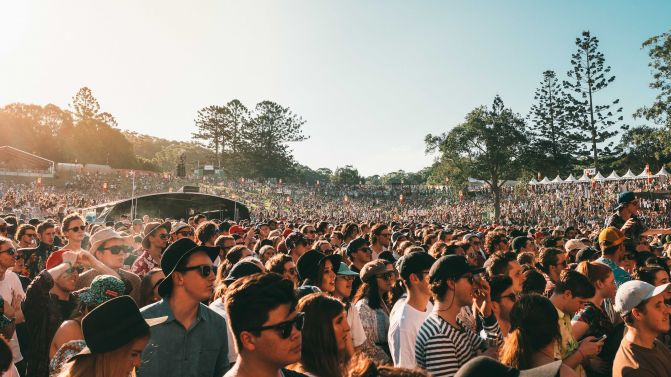
However, that factor is a double-edged sword. The affordances and techno-social dynamics of such a ‘networked public’ throw in many curve balls for practitioners to contend with. One such curveball being the presence, or conceived lack thereof, of an ‘invisible audience’. It becomes a highly improbable task to predict audience engagement, and thus adequate venue size among other things, when not all audience members are visible or co-present when contributing online (Boyd, 2011). When coupled with the spreadability encouraged by participatory culture and audience numbers can quickly grow past those which are predicted or even observed. Practitioners must also make sure to not just cater to the most vocal demographic, paying special attention to the audience power of those that slip under the radar.
The use of such a personal and practitioner-audience power balancing media as social media to market events has the capacity to make a practitioner’s brand highly accessible and personable but also carries with it other burdens. Small-scale practitioners may find the collapsed contexts of social media leads to the bleeding into each other of their personal and professional lives. This ‘presence bleed’ occurs when contexts collapse and lack of spatial, social and temporal boundaries makes it difficult to maintain distinct social contexts (Boyd, 2011) and can lead to private information being unwantedly leaked and accessed. To combat this, practitioners can perform ‘boundary work’ to try to separate social context as much as possible by separating platforms, using multiple profiles, curtailing information, and more (Quinn & Papacharissi, 2018, p. 358).
Entrenching one’s brand into a networked public on a personal level through social media may raise aforementioned privacy concerns but is invaluable as it allows the practitioner to see what their audience is seeing, experiencing and, therefore, thinking and feeling. This empowers the practitioner to forge a greater bond with the audience, which is crucial as the creative market gets more and more competitive.
Social Media has changed how professionals on all levels, from international festival organisers to local gig organisers, in the music event management field engage with audiences. It has also shifted the very ‘role’ of the audience, enabling and empowering them, meaning that practitioners must cleverly utilise them to gain an edge.
Bibliography
Dueze, M. (2011). Media Life. Media, Culture and Society, 33(1), 137-148. doi:https://doi.org/10.1177/0163443710386518
Rosen, J. 2006. “The People Formerly Known as the Audience.” PressThink: Ghost of Democracy in the Media Machine, June 27. http://archive.pressthink.org/2006/06/27/ppl_frmr.html
boyd, d. 2011. “Social Network Sites as Networked Publics – Affordances, Dynamics, and Implications.” In Papacharissi, Z. A Networked Self – Identity, Community, and Culture on Social Network Sites, 39-58. New York: Routledge
Quinn, K. and Papacharissi, Z. (2018) Our networked selves: Personal connection and relational maintenance in social media use. In J. Burgess, A. Marwick, and T. Poell,(eds.) The SAGE Handbook of Social Media. London: SAGE. pp.353-371.
Eventbrite. (2016, July). Hardcore Festies: The Driving Force Behind Todays Growth in Music Festivals. Retrieved from Eventbrite: https://www.eventbrite.com/blog/academy/hardcore-festies-most-valuable-fan-driving-todays-growth-in-music-festivals/?utm_medium=blog&utm_source=blogpost&utm_content=TLreport&utm_campaign=2016q3music-fest

 Watt0 Music